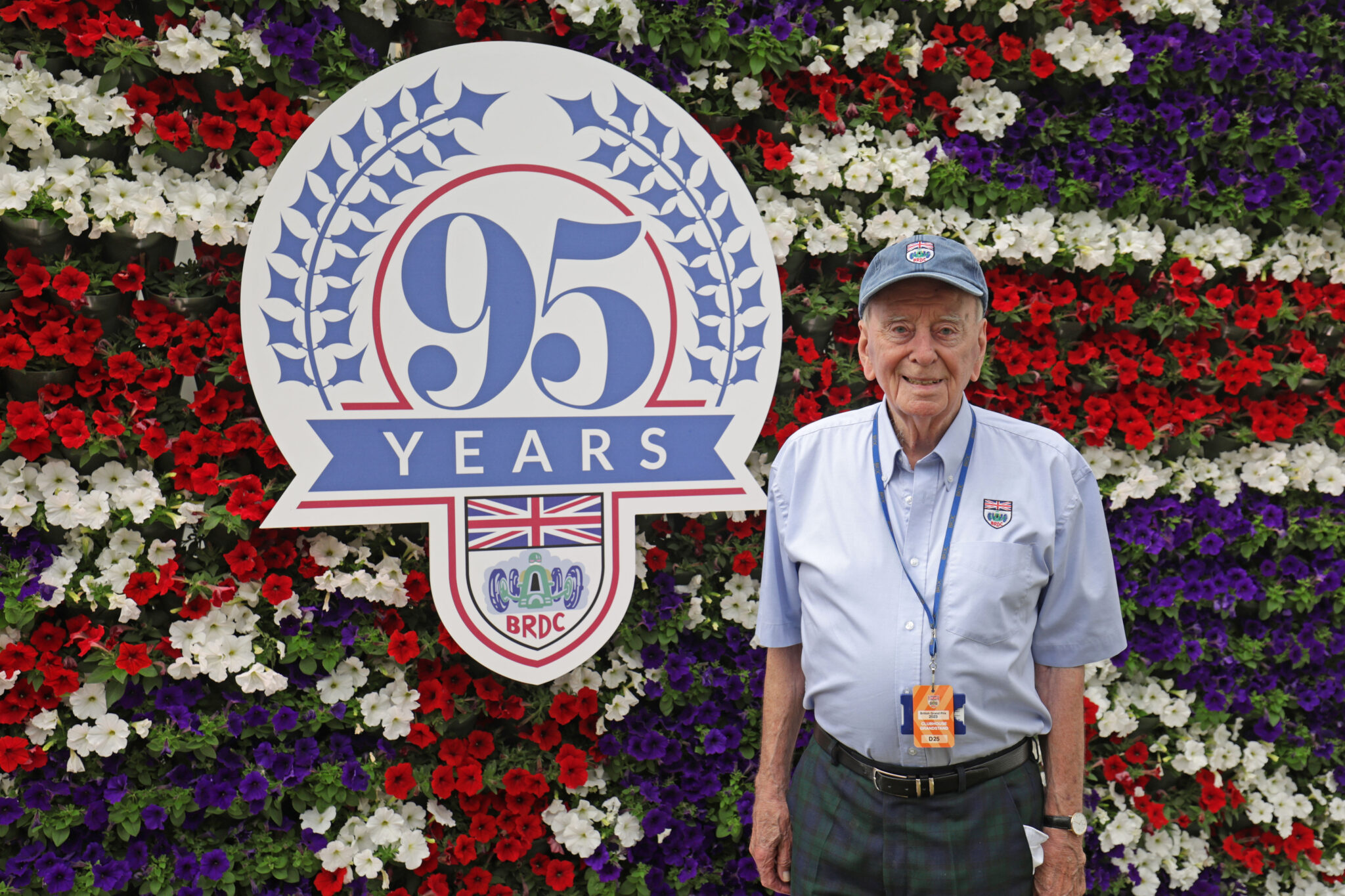
It is with great sadness that the Club must report on the death of one of its Members of longest-standing, Micky Pople. Incidentally born on the year in which the BRDC was formed, Micky was a popular figure in the Club and was elected as a Full Member of the BRDC in 1952. He subsequently became a Life Member in 1978. An in-depth article about Micky’s racing career featured in issue 250 in Octane magazine in April 2024, written by Simon Charlesworth. Octane have kindly given the BRDC permission to post this on the Club’s website, with the BRDC’s sincere thanks. Funeral details will be posted here once they are known by the Club.
Reproduced from The Octane Interview, Octane issue 250, by Simon Charlesworth. Subscribe to Octane at octane-magazine.com/subscribe/
The files, now empty, have covered the table. Precious correspondence, photographs, books, trophies and medals from Micky Pople’s racing years now form a large moving collage. ‘So much rubbish,’ chuckles Micky as he sifts through everything. Every now and then, he singles out a photo or a document to recount a tale. Names and anecdotes tumble from his lips. Dinner with Jochen Rindt. Golf with Douglas Bader. Chatting with Archie Scott Brown. Racing around Hyde Park with Jean Simmons and Stewart Granger in their Bristol 402s. Les Leston, Donald Healey, Stirling Moss, Reg Parnell and Fangio. The perils of drifting a Comet tank on cobbles…
Born in Burnham-on-Sea, Somerset, Micky began his competition career in December 1949 at the Mendip Vale Hillclimb. He was 21 and driving his birthday present, a new MG TC. ‘It had a hand-operated clutch because I hadn’t got my wooden leg by then.’ It was the loss of his left leg below the knee, in a shotgun accident when serving as an officer in the 5th Royal Tank Regiment, that led him to a new sport. While his father had raced cars on Brean Beach, fellow Burnhamite and HRG owner John Buncombe took Micky on his first motorsport outing.
A photograph from his Army days is then handed over. It’s ‘Scotty’, a USAAF airman who taught Micky to fly Douglas C-54 Skymasters. ‘Somewhere I’ve got some pictures of us being buzzed by Russian MiGs… I was on the Berlin Airlift,’ he reveals with the sort of nonchalance only his generation can wield so lightly.
‘I had a little job to do, to try to suss out what the Russians actually had on the frontline. In Fassburg, the Americans wouldn’t deal with the displaced persons; I was seconded to them – with the Fifth Tanks – and we’d moved from Hamm up to the border with a view to taking a convoy to Berlin. Of course, the politicians chickened out! We could’ve done it easily, the Russians couldn’t have stopped us… I discovered that when I was flying with the Americans and we used to wander a bit off the corridor, that’s when the MiGs would appear.’
Moving back from MiGs to MGs, Mickey took ownership of his TC during the ‘Export or Die’ years. ‘A chap who used to live opposite us, Ken Harcombe, worked for the Bristol Motor Company; he told me, “I know a lady who ordered an MG before the war and it may be due to come through. We’ll just keep quiet!” It was delivered on my birthday,’ he smiles.
By 1950 his diary was soon filled with local trials and sprints, and Micky’s first circuit race took place on 31 March at Castle Combe. ‘I was third in the 1½-litre class, behind Mike Hawthorn, who was nearly a lap in front in his old ex-works 1936 TT Riley Sprite. He was very quick.’
The two rivals didn’t exactly hit it off but, even so, the Castle Combe result boosted Micky’s profile because he’d beaten Ted Lund in one of the newer works-supported TDs. ‘I was taken on as a private driver for MG’s works cars. Afterwards I did rallies, sprints, hillclimbs, everything, and I won the MG Car Club’s Hanks Trophy in my TC in 1950. Reginald Hanks [chairman of Morris Motors] presented this trophy to the best driver of the year,’ says Micky. ‘Some 50 years later I went back and presented it to the next winner at Silverstone.’
The following year, Micky became a team driver via his relationship with fellow racer Trevor Lines. ‘He and I were great friends,’ he says. ‘My next race was the British Empire Trophy Race on the Isle of Man in June 1951. I was third in class and that’s when I met the friends I teamed up with and joined the Monkey Stable.’
Founded in the winter of 1950-51 by Jimmy Mayers and Patrick Griffith, the Monkey Stable took its name from the constructor of their Lester-MGs, Harry Lester, and was a cheeky reference to his physique. It’s believed that 12 racers drove for the team over the years. Micky was closest to Trevor Line, Mike Keen, Peter Avern, Alan Brown and Mike Llewellyn.
‘That British Empire Trophy race was the famous occasion when the big cars didn’t like it. Several of them retired with gearbox and all sorts of problems, but were perfectly able to be driven after the race. Roy Salvadori was among them, I remember, but Peter Collins – who was a great buddy of mine – had put a Cadillac engine into his Allard. He’d been left some money by an aunt in America and they couldn’t send the cash, so bought a Caddy engine and sent that over.’
A handicap race, crediting the 1500cc cars with four laps, the British Empire Trophy saw Micky finish seventh, just ahead of Lines, both in their TDs.
A detour into the off-track antics of racing drivers is unavoidable, not least Peter Collins racing along the corridors of Liverpool’s Adelphi Hotel aboard a trolley and swapping all the guests’ shoes. They were all thrown out. And Collins’ name naturally comes up a lot.
‘I came home with him after he crashed at the Nürburgring in 1952,’ says Micky. ‘He’d smashed up his car and couldn’t start the race, so Jean Lucas [a fellow racer and later Gordini team manager] said to Peter, “Well, we’ll take my car.” I can’t remember which one it was, it was one of the big Ferraris – a V12, and it was so bloody hot, it wasn’t true.
‘We stopped off at Reims, did a couple of laps around the old Grand Prix circuit and met up with a chap who had been in the Maquis. He took us to the grandstand and showed us where the local headquarters were during the war, it was underneath and very cleverly concealed. Then we went to Paris. Peter had got hold of so many deutschmarks – they weren’t very valuable – that I had
my artificial leg stuffed full with them,’ laughs Micky. ‘He was worried we’d get stopped and searched.’
One of the good guys, then? ‘Oh yes. We were always chatting, but of course, he was abroad so much. He was a great chap – a bit like James [Hunt] really.’ He pauses, then quietly adds: ‘Dear Peter.’
Micky’s relationship with Harry Lester was another story. ‘The Kieft-MG came out of a pub lunch when we were talking to Gordon Bedson [an ex-Vickers designer] and it was probably Pat Griffith who said that we were thinking of building a new car. The Lesters weren’t stable enough – they didn’t have independent suspension and you had to go independent. So Bedson got a piece of paper and said that you take four aluminium tubes, brace them and then you could hang what you like on that; you could stick an engine in the front or the back, fit all-independent suspension… I think it was Jim who went to Cyril Kieft and asked him to build it.
‘We put our tuned MG engines into the Kieft. Pat Griffith’s father owned Payen Gaskets and Cooper’s Mechanical Joints, so we had the thinnest head gaskets that man ever made. We took one of the engines back to MG and it was installed on a test-bed. MG’s Engineering Development Department head, Alec Hounslow, said: “This isn’t going to take long.” It was opened up to 5000rpm. “Any time now, she’ll go bang.” 6000, 6500, 7000, 7000-and-a-bit – BANG! He said, “How do you manage that?” We never told him! It was so simple, it was the oil pressure pump. They didn’t really work and the pressure built up far too high and that blew the bearings. What we’d done was recalibrate the pump!’
Micky’s smile then breaks into a chortle as he remembers the first Kieft. ‘The petrol tank was secured with bungee cords! We were testing it somewhere, maybe Brands. Of course, the tank came off. So we had to get better fixings. It was an extraordinary car, it held the road better than almost any other. It had a central driving position and a central gearbox, but for the regulations, there was just room to squeeze a passenger alongside.’
Micky’s first visit to the Nürburgring – a circuit that remains a great favourite – was in 1952, when he competed in John Buncombe’s Healey Silverstone and drove Alf Hitching’s Cooper-MG. ‘Yes, you were on a racing track, but it felt just like a glorified country road really. You had plenty of time,’ says Micky.
Alas, the details of that July race have disappeared, but it contributed towards him being elected to the BRDC. However, his next race at the ’Ring, the 1953 Nürburgring 1000km, certainly did not. ‘I remember Mike Keen at the 1000km, I think we started twenty-something in the general classification, then the first time he came around he was 13th. He’d passed all the big boys on the corners and the only time they could get past him was on the straight. So when I got in, I think I was about tenth. Of course, then the bloody wheels broke! It was a pity because we would have done very well – that little car went like a rocket, it was extraordinary.’
As disappointing as the 1000km retirement was, the Monkeys had been noticed thanks to Mike’s magnificent fifth place at the Rheinland-Pfalz Preis in early August.
Meanwhile Trevor Line had bought the chandlers in Salcombe, Devon, a business that happened to look after boats belonging to the White family, founders of the Bristol Aeroplane Company. Micky’s introduction to BAC, however, came from Roger White-Smith, who worked at Filton and was the regional boss of the MG Car Club. He introduced Micky to the manager of the Car Division’s Racing Department, Vivian Selby, a man keen to encourage young talent. The team’s negotiations were handled by Jim Mayers, as Micky recalls: ‘I wouldn’t say he was difficult but he was a single-minded chap.’
Jim, Mike Keen, Trevor Line and Micky (as reserve driver) joined Peter Wilson, Tommy Wisdom and Jack Fairman as part of Bristol’s three-car team for 1954 at Le Mans and Reims, and Le Mans again in 1955. The team did well, dominating the Le Mans 2-litre podiums (first, second and third) for two successive years. Micky drove during practice in 1954 – regulations meant his leg precluded him from competing. It’s a race he didn’t like because of the speeds involved, particularly as the mid-pack 2.0-litre cars were constantly being overtaken, ‘but the boys did very well’, he says. Indeed, at each of Bristol’s subsequent races, the leading Bristol always had a Monkey in its driver partnership.
Unfortunately, Bristol’s success came at the expense of the Monkey Stable, which didn’t race again. There were plans for long-distance racing in a new Lester-MG, but the car was behind schedule and suffered poor handling. Then, in 1955, the tragic loss of two drivers – including their leader – meant the end for the Monkey Stable.
‘Mike got killed at Goodwood in a rear-engined T40 Cooper-Bristol. Then Jim was killed when partnering Jack Brabham in a Cooper-Climax T39 at Dundrod in the RAC TT. I’d just got married, my co-driver Mike was dead and I thought too many people were being killed. It was just awful, so I gave up.’
Micky retired from racing in 1955, but he wasn’t quite finished with Spa or the Nürburgring – parts of which he describes as ‘absolutely gorgeous, really fast and not too aggressive’. Since 1955 he has returned there for many a trackday. So often, in fact, that putting a number on all the laps and mileage prior to his ‘ban’ five years ago (when aged 90) is more or less impossible.
As for this ‘ban’, Micky, who instigated it? He leans forwards, smiles and whispers: ‘Mrs Pople!’