
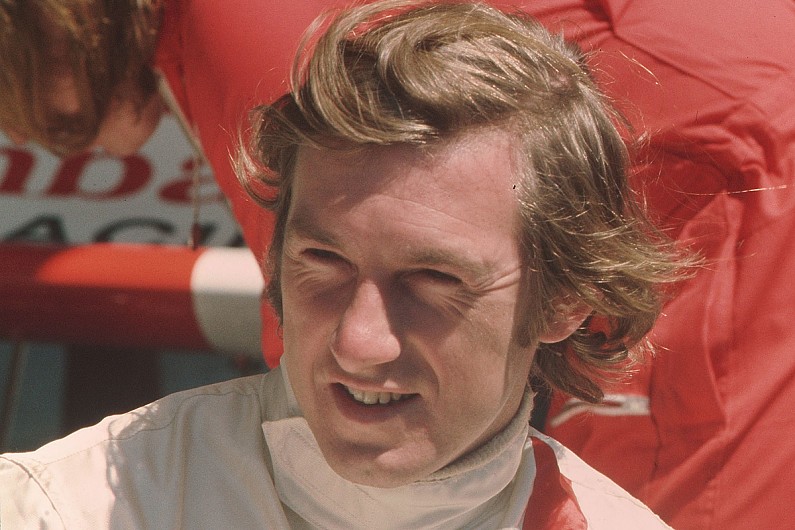
Guy Edwards, who passed away on the 19th of June, left his mark in more ways than one on the world of motor racing. He was no mean race driver, becoming one of the most successful drivers in the Aurora British Formula 1 and European Formula 5000 Championships and in international sports car racing. He was a trailblazer in sourcing and securing sponsorship deals. His autobiographical book entitled Sponsorship and the World of Motor Racing, when published in 1992, immediately became the definitive work on the subject. And in the1976 German Grand Prix he was one of the drivers who stopped to rescue Niki Lauda from his Ferrari fireball, for which he was awarded the Queen’s Gallantry Medal.
Born and brought up in the Liverpool area, Guy had no interest or family involvement in motor racing until he went with some friends to nearby Oulton Park one day in 1959 and was immediately hooked. From Liverpool College to Durham University, from where he graduated with a joint honours degree in Geography and Psychology, Guy immediately made a bee line for Brands Hatch with a view to becoming a professional racing driver. To keep body and soul together Guy freelanced as a china and central heating salesman while racing first a Ford Anglia and then a Mini-Cooper S on which all his limited spare funds were expended. On a trip to Karlskoga in Sweden, Guy clinched his first sponsorship deal with the ferry company, bartering a cabin for a couple of Tor Line Ferries stickers on his Mini. Mixing it with assorted Fords including a Galaxie or two, Guy won his class, crossing the finish line just as his engine disintegrated in a cloud of smoke.
Renowned Heating, Guy’s employers, were persuaded to part with enough funding for some 1-litre Formula 3 racing in an uncompetitive Lola T62 but this ended when Guy left the company, his best F3 result being a ninth place at Brands Hatch. But the Karlskoga result had not been forgotten by Tor Line’s owner who, with some judicious coaxing from Guy, agreed to cover the cost of a new Chevron-BMW B8 for a season of sports car racing in Northern Europe in 1969. Today sponsorship ranging from full-car liveries to some stickers are commonplace, but it was only in 1968 that this became permissible. Previously only advertising directly associated with the car itself, such as fuel and tyres, had been allowed by the FIA and RAC rules. The change could not have come at a better time for Guy. Sharing with his friend, and a future BRDC Member Mike Franey, Guy achieved a best result of fourth overall in the Barcelona 12 hours.
Tor Line did not continue its sponsorship into 1970, but Guy had secured a replacement in the guise of Philips Autoradio which funded the cost of running an Astra RNR2 in a full season of sports car racing in Europe and the UK. Unfortunately, this car, with its unique bonded plywood chassis, was an unreliable disappointment, its one redeeming feature being to hold together long enough to enable Guy to win the Benelux Trophy on Philips’s home circuit of Zandvoort. However, Guy had cultivated a good relationship with Philips who agreed to the acquisition of a new Lola T212 for 1971. The Lola was a distinct improvement on the Astra and brought Guy victories at Nogaro and Crystal Palace plus some strong results in South Africa at the end of the year.
Keen to resume his single-seater career in parallel with the sports-car racing, Guy came to an arrangement with John ‘Butty’ Butterworth to race the latter’s Formula 5000 McLaren-Chevrolet M10B in the British-based International Championship for these cars, making his debut in the Brands Hatch Victory race for both Formula 1 and Formula 5000 machinery, a race which was stopped prematurely after Jo Siffert’s fatal accident in a BRM P160.
For 1972 a new Lola T290 replaced the T212 with backing from Barclays International, the season starting well with victory at Snetterton in the Anglia Television Trophy round of the RAC British Sportscar Championship. A few weeks later, in the Brands Hatch 1000 Ks round of the World Sports Car Championship, Guy finished seventh overall and first in the 2-litre class with David Hobbs as co-driver. Second places were achieved in the very competitive European 2-litre Sportscar Championship races at Silverstone (Martini Trophy) and Vallelunga (Trofeo Ignazio Giunti) and Guy ended the season fourth in the final championship standings.
The first full season in Formula 5000 produced solid results with the McLaren M10B in what was by now an obsolete car, Guy’s best finishing position being seventh place at Mondello Park. The deal with Barclays International continued into 1973 with a Lola T332 in Formula 5000 and a Lola T292 in sports car racing. By now Guy had shed his reputation of being quick but inclined to have accidents and had matured into one of the front-runners in European 2-litre sportscar racing. One of the highlights of the 1973 season was victory in the Trophee d’Auvergne on the challenging Charade circuit near Clermont-Ferrand while there was also a victory in the Trofeo Ignazio Giunti at Vallelunga. In the drivers’ championship Guy had finished fourth in 1972; one year later he was leading the final round on the Montjuich road circuit near Barcelona, and on his way to taking the title, when a camshaft failed and he was forced to retire, enabling Chris Craft to take the title from John Burton with Guy having to settle for third.
In Formula 5000, armed with the state of the art Lola T332, Guy showed his ability to handle much more power than he had previously encountered, immediately becoming a front runner and taking his first victory at this level by a fifth of a second from Tony Dean’s Chevron B24 at Zandvoort in September, followed a month later by a mightily impressive victory in the Motor Show 200 final round of the Championship at Brands Hatch when he drove a storming race to recover from being bumped down to 10th place at the start.
For 1974 Guy used all his persuasive powers and sponsorship-securing experience to take the second seat in Graham Hill’s Embassy Lola team. He had risen through the ranks from sports car racing to Formula 1 in just five years. For various reasons, it wasn’t a happy experience, Guy having to stand down mid-season after fracturing his wrist while testing his Formula 5000 Lola at Mallory Park after which Graham declined to allow him back. His best results were seventh at Anderstorp in the Swedish Grand Prix, and eighth in Monaco, results which in the 21st century would be worth world championship points but not back then. However, on his return to racing with the Formula 5000 Lola T332, Guy won at Mallory Park which was the only race win which Embassy ever achieved.
Despite the Mallory Park success, Guy was not reinstated by Graham Hill and found himself out of Formula 1 having worked so hard to be there. Eventually he was able to agree an ingenious sponsorship arrangement with Encyclopaedia Britannica which, while not bringing him any wins in 1975, produced several strong podium finishes and third place in the SHELLSport European Formula 5000 Championship.
A return to Formula 1 in 1976 with the post-James Hunt iteration of Hesketh Racing did not prove very successful, the Hesketh 308D only finishing three of the six Formula 1 races for which it was entered. Towards the end of the 1976 season Guy showed that his speed had not been lost by comfortably winning the Oulton Park Gold Cup in a RAM Racing Brabham BT42. His last outing in Formula 1 was a hopeless attempt to qualify the uncompetitive Stanley BRM P207 for the 1977 British Grand Prix at Brands Hatch.
Although his aspirations to race at the highest level in World Championship Formula 1 had been thwarted, Guy was far from finished with Formula I at national level and over the next few years became one of the principal supporters of the SHELLSport International Series which changed its name to the British Formula 1 International Series for 1978. With a RAM Racing March 761 in 1977 Guy won races at Thruxton, Snetterton and Brands Hatch to finish second in the series to Tony Trimmer and the following year a March 781S brought him victories at Oulton Park and Thruxton and fourth place in the Championship. For 1979 Guy and RAM Racing had a Fittipaldi F5A at their disposal. For the 1980 season Guy had an Arrows A1B which enabled him to secure victories at Snetterton and Oulton Park whilst other regular visits to the podium brought him third place in the final championship standings.
By 1981 the UK’s version of Formula 1 was withering away and so Guy reverted to sports car racing with a Lola T600 sharing the driving and the cost with one of his main rivals from the Aurora AFX British F1 Series, Spanish banker Emilio de Villota. The Anglo-Spanish pairing won rounds of the World Sportscar Championship at Brands Hatch and Enna-Pergusa (the Coppa Florio) while Guy was also to be seen at Le Mans where he finished fourth in 1985 in a John Fitzpatrick Racing Porsche 956B shared with David Hobbs and Jo Gartner which was his best result in several attempts. His last two racing years were spent with a Kaliber-sponsored Ford Sierra RS500 in the British Touring Car Championship as team mate to Andy Rouse, taking several second and third places and sharing one of the Rouse cars with Jonathan Palmer to sixth place in the 1988 RAC Tourist Trophy round of the European Touring Car Championship at Silverstone.
Guy retired from the cockpit at the end of1989 but became ever more heavily involved with motor racing sponsorship. He placed Castrol with Team Lotus in Formula 1 and in the American IMSA Sports Car Series. Perhaps most memorably he brought together Jaguar and Silk Cut for Le Mans and, the World Sports Car Championship, both of which were winners. Guy’s reputation also made him much sought after by major companies outside motor sport, one of his clients being Heathrow Airport. In his later years Guy suffered serious disability from the effects of a major stroke. Piling tragedy on tragedy, his son Sean was killed in 2013 whilst instructing another driver at a track day in Australia; at the time Sean was emerging as an outstanding driver who had achieved notable success in the Porsche Supercup and Carrera Cup Deutschland in particular. After living in France, Guy moved to Galway, Ireland where he was always pleased to receive visits from his old motor racing colleagues. The only driver whose career Guy managed apart from his son Sean is Derek Daly who has written movingly about Guy in his recently published autobiography.
It would not be untrue to say that Guy set the standards by which anyone seeking major investment in motor racing should be guided. His magnum opus may have been published in 1992, and therefore before social media became facts of life, but much of what he wrote in the early 1990s is just as relevant now as it was then. Guy may no longer be with us but his influence lives on. Also notable is the fact that on the dust jacket of his book Guy is prominently wearing the BRDC badge on his race overalls. Guy became a Full Member of the Club in 1969 and later a Life Member. The BRDC offers its deepest condolences to Guy’s daughters Jade and Natasha, his extended family and many friends within and outside our sport. Guy’s funeral took place on Thursday 2 July 2026 but there are plans for a memorial to be held in the future and details will be shared with Members as soon as the Club receives any information.