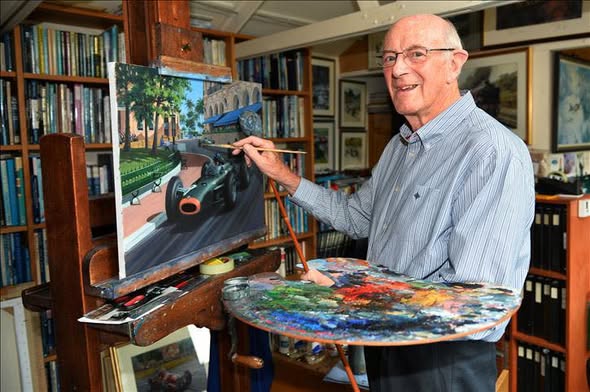
With great regret we must inform Members of the death of renowned motor racing and aviation artist Michael Turner at the age of 91. Having suffered from skin cancer for some years, Michael passed away quietly at home. Michael became an Associate Member of the BRDC in 2014.
Michael was born in Harrow. As a boy growing up in wartime London, he developed a talent for aircraft recognition and passed his time at school producing aviation sketches. His interest in cars evolved after a family holiday to the Isle of Man in 1947 which happened to coincide with the BRDC British Empire Trophy on the Island’s roads. The heady mixture of sound, smell (of Castrol ‘R’) and speed captivated the 14 year old Michael who became well and truly bitten by the motor racing bug. Back home, he prevailed upon his parents to take him to as many motor racing events as possible including the first race meetings at Goodwood and Silverstone in 1948 and, a couple of years later, the Grand Prix d’Europe at Silverstone.
A year at the Heatherly School of Fine Art was followed by two years’ National Service in the Royal Electrical and Mechanical Engineers during which time he started producing sketches for The Motor magazine. Determined to establish a career as an artist specialising in motor cars and motor racing in particular, Michael then obtained a place in commercial art studios before striking out on his own in 1957 after receiving a commission from Esso Petroleum for an oil painting of the 1956 Le Mans 24 Hour race- winning Ecurie Ecosse Jaguar D-type. In the 1950s there were comparatively few artists operating in the automotive sector, Roy Nockolds being the best known, but it was soon clear to Michael that there was a strong demand among motor racing folk for his work. To achieve the greatest possible authenticity and accuracy Michael travelled widely and came to know personally over more than 50 years many of the leading figures in motor sport including the Formula 1 drivers, team owners, sponsors, manufacturers and, from the world of aviation, RAF and Army messes.
The sets of Michael Turner Christmas cards – an idea originally conceived in conjunction with the late John Webb in 1963 – immediately became, and have continued to be, collectors’ items both for their distinctively authentic style and as a record of a year’s motor sport highlights. There cannot be many, if indeed any, Members who have never sent or received a Michael Turner Christmas Card. The cars of whatever era invariably look right. Everything is in the right proportion, be it the cars themselves or the background of marshals, spectators, pits, grandstands, barriers, recovery vehicles and so on. Part of Michael’s art was to convey on a single page, as if the viewer was there, the sound and fury of racing cars being driven to the limit by the world’s best drivers of any given era. He was also able to depict, particularly in the days before full face helmets, the drivers and their individual personalities. Michael’s client list reads like a roll call of the major figures in motor racing in the middle of the 20th century including Graham Hill, John Surtees, Sir Jackie Stewart, Jacky Ickx, Bruce McLaren, Phil Hill, Dan Gurney, Nelson Piquet, Howden Ganley, Jo Siffert Emerson Fittipaldi, Sir Jack Brabham, Chris Amon, Ken Tyrrell and Mark Webber.
When Bruce McLaren set up his own racing team in 1965, he asked Michael to design the bodywork of the second McLaren sports-racing car, the M1B, and the first Formula 1 car, the M2B.
The holder of a Private Pilot’s Licence, Michael enhanced his desire for authenticity, both in the air and on land, by flying in service aircraft from the Tiger Moth biplane and Lancaster Bomber to the Harrier and Tornado warplanes. He flew his own Chipmunk and was flown on a number of occasions with the Red Arrows including the aerobatics element of their repertoire. Michael was a founder member, Chairman and ultimately, for 36 years, President of the Guild of Aviation Artists and an Honorary Fellow of the Guild of Motoring Artists.
In his quest for authenticity Michael would walk round most of the tracks which he attended, thus enabling him to visualise in his mind’s eye incidents which he might not have been on the spot to witness as they happened. He was a regular visitor to Grands Prix, known personally to many of the Formula 1 ‘circus’, so that it was with some sadness that Michael found himself unable to obtain media facilities and access for many F1 races although Bernie Ecclestone helped as and when he could and Monaco was invariably pleased to welcome him. In recent years his interest in the sport at its current level waned although he retained his passion for racing and continued to produce paintings, sketches and illustrations in his distinctive style which combined an eye for detail and accuracy with the ability to capture the essence of Grand Prix and Sports Car Racing.
In proposing Michael for Associate Membership of the BRDC in 2014 Sir Jackie Stewart described him as probably the best known motorsport artist in the world today while John Surtees as seconder wrote that Michael captured and immortalised the finest circuits and drivers with an attention to detail which benefitted from actually being on the spot to capture the reality of the moment. John went on to say that ‘Michael’s art is the link and record to over 50 years of motorsport’.
These days there are several very good artists who specialise in motor sport subjects but for the post-World War 2 generations it is surely Michael Turner who played a major role in defining their enthusiasm and providing a definitive record of the great moments of the sport. Michael’s wife Helen pre-deceased him two years ago and he is survived by his daughters Alison and Suzanne and by his son Graham to whom the BRDC offers its most sincere condolences.